By Denise Fernandez, Ph.D.
Last updated on June 8, 2026
In February 2025, the U.S. Environmental Protection Agency (EPA) activated its Emerging Viral Pathogens (EVP) policy against “viruses causing Ebola disease (including Sudan virus)” following the January 29, 2025 declaration of a Sudan virus outbreak in Uganda. The EVP policy against “viruses causing Ebola disease” remains active through May 2028. In alignment with EPA’s List Q descriptions, viruses causing Ebola disease are considered Tier 1 for difficulty to inactivate, similar to other enveloped viruses including Mpox virus, Marburg virus, and SARS-CoV-2.
More recently, Health Canada’s Natural and Non-prescription Health Products Directorate (NNHPD) has also triggered its Emerging Viral Pathogen policy for Ebola-related viruses. However, unlike the EPA, Health Canada has chosen to activate its policy specifically for Bundibugyo virus, one of the viruses known to cause Ebola disease, rather than for the broader group of orthoebolaviruses. Although both agencies have activated their respective EVP programs for Ebola-related pathogens, the Canadian and U.S. policies differ significantly in their scientific support requirements and allowable claims. Manufacturers should not assume that support for an EVP claim in one jurisdiction automatically translates to eligibility in the other.

As shown in the comparison, NNHPD’s EVP framework permits both off-label and direct label claims when supported by the appropriate data package. In contrast, EPA’s EVP program primarily allows pre-approved off-label communications until pathogen-specific efficacy testing has been completed and accepted.
Ebola Disease
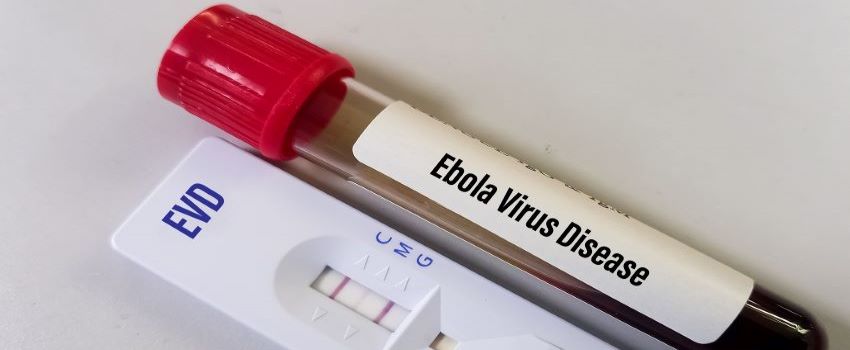
Ebola disease is caused by a group of viruses, known as orthoebolaviruses (formerly ebolavirus), and are found primarily in sub-Saharan Africa. There are four viruses that cause Ebola disease in humans: Ebola virus, Sudan virus, Taï Forest virus, and Bundibugyo virus. Ebola disease can be contracted by contact with body fluids (or objects/surfaces contaminated with body fluids) from an infected, sick, or deceased person and more rarely, disease can be the result of contact with an infected animal, for example, a bat or a primate. People exposed to the virus may develop symptoms 2 – 21 days after contact with the virus, with an average of 8-10 days after exposure before symptoms develop. The mortality rate is as high as 80-90%.
The Pathway to Make Off-Label Claims Under EVP
Once activated against a particular virus, the Emerging Viral Pathogens Policy (EVP) allows registrants to make indirect, pre-approved off-label statements against the virus(es) for which the policy is active. To be eligible to make EVP claims against “viruses causing Ebola disease”, a product must have previously demonstrated effectiveness against at least one large or one small, non-enveloped virus. SRC has confirmed with EPA that it is acceptable to include any of the four viruses that cause Ebola disease (Ebola virus, Sudan virus, Taï Forest virus, and Bundibugyo virus) in EVP communications. Indirect claims convey to the user that the product is anticipated to be effective against the emerging viral pathogen based on a product’s demonstrated efficacy against other harder-to-kill viruses. Approved EVP communication outlets include technical literature distributed exclusively to health care facilities, physicians, nurses, and public health officials, “1-800” consumer information services, social media sites, and company websites (non-label related).
An example of allowed communications could be a social media post with the following:
“[Product name] has demonstrated effectiveness against viruses similar to [Ebola virus*] on hard, [porous and/or non-porous surfaces]. Therefore, [product name] can be used against [Ebola virus*] when used in accordance with the directions for use against [name of supporting virus(es)] on [hard, porous/non-porous surfaces]. Refer to the [CDC or OIE] website at [pathogen-specific website address] for additional information.”
Testing Against Viruses Causing Ebola Disease
To make direct, on-label claims against any of the four viruses that cause Ebola disease, efficacy testing is required to be conducted on the claimed virus. Ebola disease viruses are not currently available at any of the standard U.S.-based contract testing laboratories due to the classification of these viruses as Select Agents and the requirement for a BSL-4 facility for virus handling. To date, no surrogate virus for Ebola disease-causing viruses has been approved for testing by U.S. EPA. SRC will continue to monitor availability for direct testing against these viruses and provide updates to clients regarding options for testing and claims.
Please contact SRC with any questions regarding how to support an EVP claim against Viruses causing Ebola disease (including Sudan and Bundibugyvirus) or for assistance achieving EVP approval for your product SRC will continue to monitor developments related to Ebola-related EVP activations, including any future EPA and Health Canada updates.